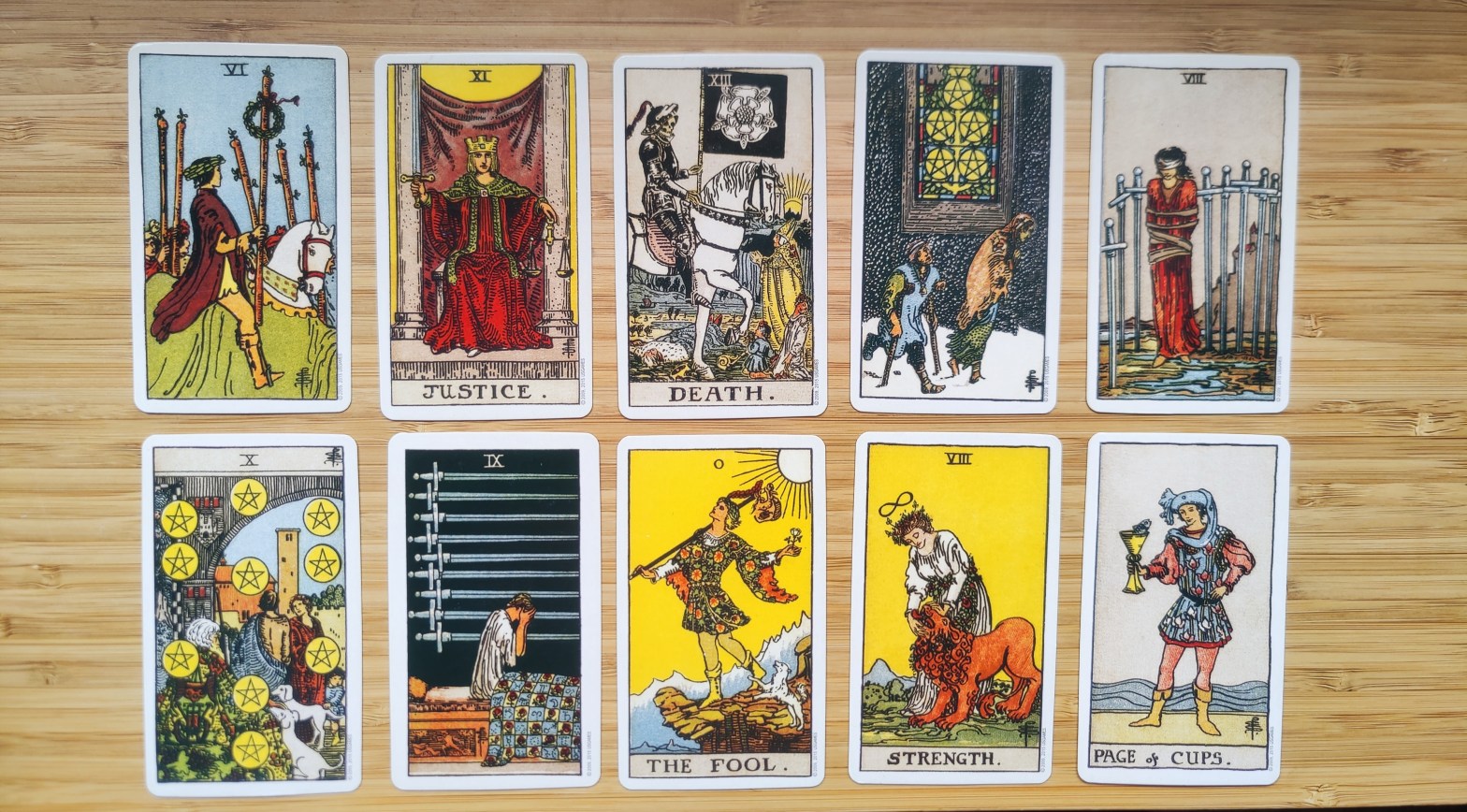
I was recently listening to the BBC podcast, Witch. It was all about the history of witches right up to the modern day. One episode talked about divination, in particular about tarot readings. Hearing the readers talk about how they use the tarot it sounded like many of them were using them as a type of psychotherapy. And there are lots of different decks of cards that therapists use with their clients, usually depicting a range of situations or emotions, and the client can use these to investigate, understand and express their own experiences of the world. I have always found the idea of the tarot quite magnetic, even though I don’t believe in fortune telling, and this felt like the perfect excuse to scratch that itch.
So I bought a tarot deck. It is the Rider Waite Smith deck, probably the most well known of the tarot deck, and one that has been reimagined in hundreds of ways, including a cute kitten version that I didn’t know I needed until I saw it. There are 78 cards in this tarot deck, and they seem to cover pretty much all of the bases of human experience and development. There is a trump suit of 22 cards, known as the major arcana, and four other suits much like a standard deck of cards, only they are wands, cups, swords and pentacles (something like a coin), and each suit has 14 cards instead of 13.
78 cards offers quite a lot of possibilities to explore. So what am I doing with all these cards? Well I don’t believe that they can be used to forecast the future. Sort of… I have actually been advised against using them with clients but a fellow therapist who is also a tarot enthusiast, in case my clients believe on some level that I am telling their fortune. What I have found is that these cards, with all their permutations, offer a brilliant way to challenge my beliefs and biases, much like the experience of working with my professional supervisor.
I am used to thinking about my work with each client, or my life in general in certain set ways that I have of valuing things. Like everyone else I am saddled with a worldview that is hard to escape. I have been trained to step outside of this fixed view more easily than most, but I cannot always know when it is pulling my strings. So when I draw a tarot card for a certain situation, it can very often force me to think in an entirely new way.
There are cards in that deck that annoy me, and bug me, and I wish they weren’t there. Cards that outline certain unpleasant truths about the human condition. When I turn one of these cards over I am forced to contend with that idea, when I would have otherwise conveniently ignored it. You could say that tarot is not for the faint of heart. On the other side of that coin, there are cards that I find to be my type of card, lovely and familiar. All of them, pleasant or unpleasant, can be inspirational.
One of the fun things I like about the tarot is the journey of personal development and mastery that it describes. The major arcana starts with the fool who is card zero, unlimited potential, and the remaining 21 cards spell out the fool’s journey. It reminds me very much of the 10 Ox Herding pictures from Zen Buddhism, a map of the path that leads to realisation. This set of cards includes many of the ones you might already know about, such as the lovers, death, the devil and the hanged man. This is another thing that I love about this deck, the colourful characters and situations, which are very often a lot less sinister than they might sound.
Each suit has a particular focus. The wands are all about fire, or our will, the force that drives us to do things and take action. In therapeutic terms I liken this to our bodies and the way they act as vehicles for our psyches, giving us the means and motivation to act. The cups are all about water, imagination and emotions, describing the different ways they can influence our choices. The swords are about air and our thoughts. This is definitely the least cuddly of the suits, cutting through the fluff into the heart of the matter. Finally, the pentacles are about manifest, earthly things, the products of our actions, both good and bad, wanted and unwanted.
So without needing to believe in magic (or witches) it is possible to gain huge insights from the tarot. It can give you pause to consider situations in an entirely new light, which will expand your awareness of your own situation and that of the world around you. It is also possible to play some very old card games with the tarot that precede their use for divination, and are gaining in popularity again.
As I have explored the tarot I have come to the personal conclusion that it is ripe for a refresh. I think that this process is already taking place in the many reimaginings of the cards, strikingly so in the Fyodor Pavlov Tarot, in which the deck showcases traditional Rider-Waite-Smith formats with additional themes of gender, sexuality and relationship diversity. This beautifully illustrated deck also explores themes of ability, and has a knight of pentacles in a wheelchair, and a nine of wands as a warrior with an amputated leg. To me this inspires thoughts of a new tarot that is no longer a matrix of occultism, Kabalah and astrology, but something drawn directly from the world we live in today, and its history. Another project to tackle in retirement, perhaps.
If the tarot is not for you, I think that the principle still stands that we need ways of challenging our set ways of thinking, feeling and doing, in order to get over our persistent problems so that we can keep developing as individuals, like continuing professional development, or when we go to therapy. I hope that this has sparked some inspiration for you to keep exploring and developing your experience of this life.
All the best.
Will.
 Will Farmer Counselling